Insights from the authors of Overcoming: What Scripture and Science Say About Resilience
Mandy and Nicole here, dropping by to share some insights that didn’t make it into our new book about building resilience in children.
As part of the book writing process for Overcoming: What Scripture and Science Say About Resilience, we had many discussions about what we would share and what needed to be pruned. I imagine nearly all writers experience this tension in some way, having too much to share on a topic than what can be reasonably included in an easily readable book.
We had to prune some good things to ensure the focus and intention of the book was preserved. But now that the book is published, we’re excited to share a few extra thoughts on an important section related to the practical strategies for building resilience in children.
As background, the first half of Overcoming delves into the topics of adversity and trauma, resilience, protective factors, and attachment, explaining how these components interact with one another and their impact on children. The second half is purely practical, comprised of nine practices that can build resilience in children.
An excerpt from Overcoming
Here is an excerpt from Chapter 12 of Overcoming, “Resilience Practice 3: Create Structure and Healthy Expectations”:
Oftentimes, children who have experienced early adversity have lacked the structure and routine that allows them to know what to expect. This is common for children outside parental care but can also occur as a result of other adversities like severe illness or family instability. Constant inconsistency is an adversity of its own and can trigger a prolonged stress response that limits growth and development.202, 203 Creating structure and developmentally appropriate expectations can foster children’s belief that they have what it takes to survive and thrive.
In reality, children crave structure. They want to know what to expect. This can take the form of daily routines, predicting how a caregiver will respond, knowing the consequences of disobeying the household rules, and more. In fact, even though they might not say it, children appreciate household rules, as they offer guidelines for expectations.
However, structure and expectations go beyond just daily routines and household rules. Beyond helping a child know what to expect of others, it is also about creating expectations of them. Sometimes, we focus so much on a child’s history of adversity or possible developmental delays that we fail to have expectations of what a child can do. Although this can seem like kindness or grace, it deprives a child of the understanding that she has something significant to contribute. We need to be careful not to make our expectations too high or low, but we need to have expectations.
Zone of Proximal Development
For children with a history of adversity, knowing what those expectations should look like can be tricky. Their chronological age (in years) may not match their developmental stage (their abilities and behaviors). Let’s take a closer look at what this could mean. One approach is to consider zones of proximal development. Vygotsky (1978) introduced this theory, which says that each individual has a range of ability to perform certain tasks.204 In other words, one 4-year-old child might be able to tie his shoes even though he has not yet mastered this without help. Another child might never be able to tie his own shoes, so his range of abilities is different. Proximal activities are skills that an individual will soon be able to accomplish independently but still needs guidance and practice to do so.
As children receive training from invested caregivers and have positive social interactions that allow them to try out these new skills, they can move through zones and progress towards achieving their full potential.205 Learning to ride a bike is a simple example. A child starts on a bike with training wheels and, at that time, might be able to ride without training wheels if an adult walks alongside, holding the bike upright. However, the child cannot ride the bike without training wheels or adult assistance. In this example, the child’s current zone is training wheels, and the zone of proximal development is riding the bike without training wheels.
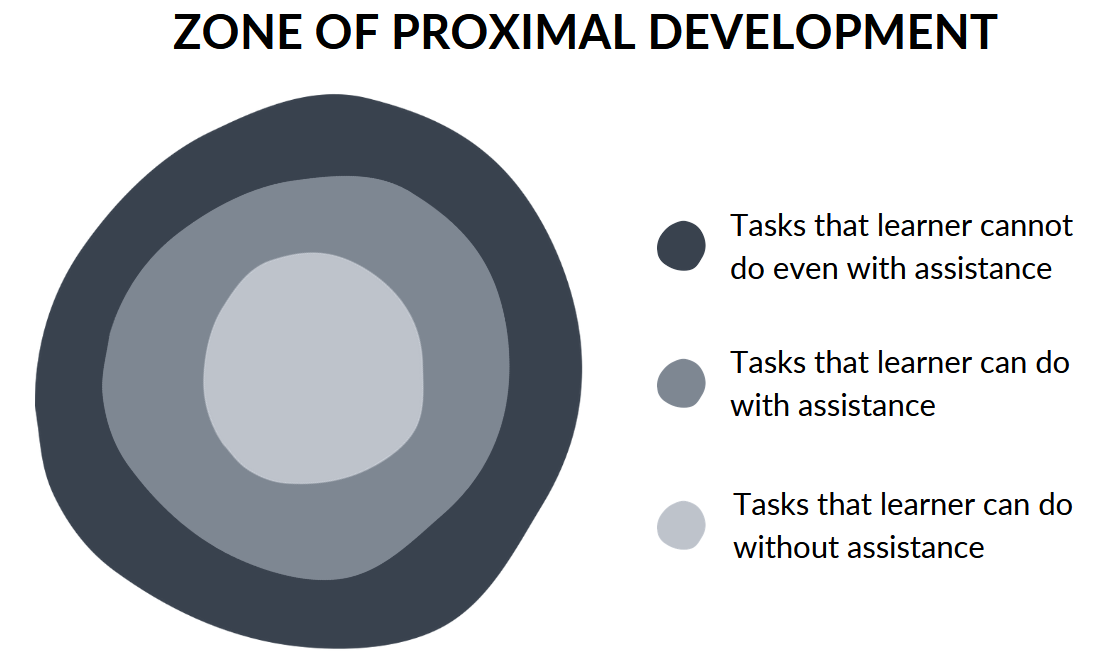
A Graphical Representation of Zone of Proximal Development206
The book goes on to share a practical example of what it can look like to come alongside a child who doesn’t yet have the capacity to accomplish a certain task by:
- Identifying the child’s current capacity for the particular task;
- Determining the next step toward developing that capacity (the proximal activity);
- Providing support to help establish the skills needed to master that activity.
While the Zone of Proximal Development framework can be incredibly useful in supporting growth and development (and thus, nurturing resilience) in children, it’s not always a straightforward concept.
We’re here to share a few additional thoughts on this topic that didn’t make it into the book but may be helpful as you apply this concept with the children you love and support.
The value of a supported struggle: A note from Nicole
This topic can be a difficult one for parents and caregivers, but it’s one of my favorites.
I once presented this to a group of child welfare professionals, and one woman who had adopted her children as teenagers had an especially difficult time with the idea of permitting any difficulty in her child’s life. She stated that her children had experienced a lifetime of hardship, and she saw it as her job to protect them from further challenges.
I can see her perspective, and it’s so easy for any of us who love our children deeply to feel the same. We grieve over the difficult things our children have experienced, and we would gladly take them away if we could. We want to counterbalance the bad with ease and comfort and simplicity.
Further, we may feel that we are called to serve our children, just as Christ led through servanthood. These are all understandable aims. However, if we aren’t wisely measured in this, we can unintentionally hurt the child we love by shielding them from challenges.
Of course, we should always protect our children from true harm – things like violence, abuse, neglect and exploitation. These things are never okay.
However, there are all sorts of other irritations, difficulties, and challenges that our children need to learn to overcome. They aren’t always going to want to do chores or to complete homework or to write that thank you letter to Grandma. They might not be keen on talking to their teacher about a low grade or looking after their younger siblings or doing the right thing when faced with a difficult situation.
Nonetheless, we don’t actually serve them well if we fight their battles for them.
In order to be overcomers, children need to know how to overcome. The only way they learn the process is by doing. They need to overcome irritations and annoyances, consequences and frustrations. They need to develop a track record of facing a hard thing and conquering it.
And here’s the hard truth: your child’s future boss is not concerned with the hard things she has experienced. His future professor still expects the same quality of work from him as from other students. His future spouse will still be deeply hurt if he lacks self-control or is prone to frequent outbursts.
We may be able to pad their present reality with certain accommodations in the short run, but in the long run, society will not make exceptions for our children because of the early adversity they have experienced.
However, we can prepare them to succeed. We can equip them to fulfill their potential. We can cast a vision for what is possible and train them – one choice at a time- to achieve it.
We may want to protect them from challenges, but in the end, empowering our children to overcome is one of the most important gifts we can give them.
The space between support and independence: A note from Mandy
In this chapter, we discuss Vygotsky’s Zone of Proximal Development using the example of learning to ride a bike. However, as a homeschooling parent, I’ve had the unique opportunity to watch this concept unfold daily with my sons.
Particularly telling was watching my older son learn to manage his schedule during our transition to more independent work in high school.
As homeschoolers since kindergarten, we had the flexibility to gradually build this skill, but by 9th grade, we knew he needed more ownership of his learning journey. The jump from parent-directed learning to juggling multiple subjects independently was significant, even in our homeschool environment. The expectation that he’d just ‘figure it out’ wasn’t working, despite having the advantage of years of one-on-one instruction and intimate knowledge of his learning style.
Instead of me either maintaining complete control (too restrictive) or suddenly expecting total independence from him (too overwhelming), we created what I now recognize as a perfect ‘zone of proximal development’ approach.
We started with a simple whiteboard system. Every Sunday evening, we’d sit together at the kitchen table – him with his assignment sheets, me with colored markers. I showed him how to map out the week, using different colors for different subjects and breaking larger projects into smaller chunks.
For the first month, this was our routine – sitting together, planning together. Then gradually, I started asking him to fill in the board while I watched and offered suggestions.
Some weeks were rough – he’d forget to include a major assignment or underestimate the time needed for a project. But these weren’t failures; they were learning opportunities. The beauty of homeschooling meant we could adjust in real time, tweaking our approach based on what worked best for him.
By Christmas break, I moved to simply checking the board after he’d filled it out. By the end of the year, he was managing independently, using a planner he’d chosen himself.
The system he developed wasn’t exactly like mine – he preferred using his own calendar with alerts – but that’s exactly the point. The structure helped him discover his own way of creating order. Now, as he navigates 10th-grade coursework, this foundation of self-management has proven invaluable.
What fascinates me now is how this gradual increase of responsibility built not just organizational skills, but confidence.
When Nicole and I wrote about nurturing children’s belief that they have what it takes to survive and thrive, this is exactly what we meant – though I wish I’d included this example in the book!
The sweet spot of finding your child’s growth zone in daily challenges
Throughout the writing process of Overcoming, it was important to both of us to approach this topic of nurturing resilience in children not just from a professional lens, but also from a personal perspective.
We are both moms who know the challenges of raising children and who believe they can do hard things. Our lives have both been touched by the reality of the impact that early adversity can have on vulnerable children, and we know how hard it can be to help children overcome that adversity.
We see you in this daily work of building resilience in the children you love. We understand those moments of doubt when you wonder if you’re pushing too hard or not hard enough. We’ve been there too, questioning our choices, even as we write about them.
But here’s what we know with certainty: every time you attune to a child’s needs, every time you create that safe space for them to struggle and grow, every time you show them through your presence that they are capable of doing hard things – you’re doing sacred work.
It may not feel noteworthy or even particularly important in the moment, but these daily acts of balanced support are quietly revolutionary. They’re helping to shape a child who will face life’s challenges with the knowledge that they can handle what comes their way. We don’t have to do this perfectly; we just have to stay present and connected.
In the end, resilience grows not from the absence of struggle, but from the presence of support – and that’s exactly what you’re providing, one small moment at a time.
_______________________

Drs. Nicole Wilke and Mandy Howard are coauthors of Overcoming: What Scripture and Science Say About Resilience, a new book that provides key insights for understanding adversity and resilience in children, along with practical strategies for nurturing that resilience in children.
You can download a free chapter of Overcoming, an invaluable guide to understanding the impact of early adversity and the importance of resilience.