U.S. Foster Care Statistics 2026
Last updated May 27, 2026
But that’s sadly not the reality for hundreds of thousands of children in the United States.
Regardless of the circumstances that separate families temporarily or permanently, relational trauma renders children and youth vulnerable to more trauma and negatively impacts their development. But our communities can rally around children and families in foster care to change this story.
Read on to learn about the state of foster care in the United States - and what you can do about it.
Jump to an Area of Focus
- Number of Children in Foster Care
- Foster Care Demographics and Characteristics
- Statistics about Children Entering Foster Care
- Statistics About Children in Foster Care
- Statistics About Children Exiting Foster Care
- Impact of Foster Care on Children and Youth
- Statistics about Foster Care and Homelessness
- Statistics about Foster Care and Human Trafficking
- What can we do about it–together?
Number of Children in Foster Care
How many children are in foster care in the US in 2026?
While it’s challenging to know the exact number of youth in foster care, The Adoption and Foster Care Analysis and Reporting System (AFCARS) estimates there are 331,747 children in the child welfare system in their most recent report on fiscal year 2025.
According to their reporting systems, the number of youth in foster care in the United States has remained relatively stable over the past decade, with 396,000 reported children in care in 2013. The number rose in the mid-2010s, peaking at 437,000 in 2017 and 2018.
How many children are in foster care in my county in 2026?
Foster care statistics can feel overwhelming — especially large, national numbers. Your community can’t care for approximately 330,000 children. But in your county, you can work with others to care for the much smaller number of children and families who are actually in care where you live.
The More Than Enough dashboard will help you find your local foster care data and connect with other collaborators like you. Enter your county’s name to find out how many children are currently in out-of-home placements and how many are awaiting adoption. You can also see the number of licensed foster homes in your area and the number of family preservation cases.
Which states have the most children in foster care?

The most populous states have the highest number of foster care placements. As of fiscal year 2025 data, California has the highest number of foster care placements with 36,212 children currently in care, followed by Texas and Illinois with 17,520 and 16,610 children in care, respectively.
Some states like Illinois, Arizona and West Virginia have a high ratio of foster care placements to the state population. While Illinois has about 10 million fewer inhabitants than Florida, the two states share a similar number of placements.
| Children in Out-of-Home Placements (2025) | Licensed Foster Homes (2025) | |
|---|---|---|
| Alabama | 5,616 | 2,697 |
| Alaska | 2,460 | 912 |
| Arizona | 8,306 | 1,918 |
| Arkansas | 3,264 | 1,618 |
| California | 36,212 | 30,945 |
| Colorado | 4,194 | 2,179 |
| Connecticut | 3,440 | 2,090 |
| Delaware | 469 | 358 |
| Florida | 15,346 | 6,699 |
| Georgia | 10,877 | 4,495 |
| Hawaii | 913 | 702 |
| Idaho | 1,258 | 1,197 |
| Illinois | 16,610 | 6,781 |
| Indiana | 11,843 | 3,837 |
| Iowa | 3,365 | 1,951 |
| Kansas | 7,022 | 1,923 |
| Kentucky | 8,569 | 4,516 |
| Louisiana | 4,619 | 2,114 |
| Maine | 2,133 | 1,557 |
| Maryland | 3,703 | 2,270 |
| Massachusetts | 8,323 | 3,029 |
| Michigan | 9,558 | 3,718 |
| Minnesota | 5,434 | 3,186 |
| Mississippi | 3,787 | 1,699 |
| Missouri | 11,727 | 5,047 |
| Montana | 1,965 | 1,054 |
| Nebraska | 3,599 | 2,480 |
| Nevada | 4,048 | 1,209 |
| New Hampshire | 1,062 | 671 |
| New Jersey | 2,846 | 2,056 |
| New Mexico | 2,282 | 1,059 |
| New York | 14,455 | 9,936 |
| North Carolina | 11,056 | 5,820 |
| North Dakota | 1,102 | 724 |
| Ohio | 15,268 | 6,976 |
| Oklahoma | 6,171 | 3,820 |
| Oregon | 4,526 | 2,865 |
| Pennsylvania | 10,865 | 8,985 |
| Rhode Island | 1,574 | 686 |
| South Carolina | 3,322 | 2,151 |
| South Dakota | 1,698 | 805 |
| Tennessee | 8,990 | 4,840 |
| Texas | 17,520 | 6,911 |
| Utah | 1,593 | 936 |
| Vermont | 828 | 795 |
| Virginia | 5,576 | 4,506 |
| Washington | 5,480 | 4,800 |
| Washington, D.C. | 523 | 346 |
| West Virginia | 6,616 | 3,135 |
| Wisconsin | 5,687 | 2,866 |
| Wyoming | 688 | 502 |
Which states have the most children in foster care based on population?

The overall rate of children in foster care in the United States has stayed relatively consistent — 5.1 children per 1,000 in 2021 and 4.3 children per 1,000 in 2024. However, several states have seen significant changes in the rate of children in foster care over the last decade. West Virginia has seen a significant increase (11.5 per 1,000 children in 2011 to 18.7 per 1,000 children in 2024). On the other hand, the District of Columbia has seen a decrease (12.9 per 1,000 children in 2011 to 3.5 per 1,000 children in 2024).
However, foster care analysis and interpreting these changes can be challenging. In some cases, policy or reporting changes may shift numbers relative to previous years while underlying rates of vulnerability, neglect, and maltreatment may remain the same. In other cases, the changes may reveal actual positive or negative shifts caused by factors like successful family preservation programs or crises like the opioid epidemic.
Map courtesy of the Annie E. Casey Foundation
What are the major factors contributing to changes in the number of children in the foster care system?
The number of children in foster care fluctuates yearly; data alone doesn’t always paint the complete picture of child welfare. For example, in 2020, reports of child abuse and the number of children in foster care dropped. On the surface, it might sound like a success; however, the more likely reason behind the decrease was a lack of access to mandatory reporters, like teachers, who would notice and report neglect or abuse during the COVID-19 pandemic.
According to the National Council for Adoption, “It is important to remember that an increase or decrease in the number of children entering foster care should not be our measure of success. Rather, our goal should be to reduce child maltreatment rates, reduce time spent outside permanent family care, and reduce timeframes and numbers of children awaiting adoption.”
Foster Care Demographics and Characteristics
What age are youth in foster care?

Children can enter the foster care system as early as infancy and up until age 18, and in some cases even older. In 2025, more than half of children were 10 years old or younger and 28% were between 11 and 16 years old. The table below shows the age breakdown of children in care in 2025.
How many newborns are in foster care?
People often guess that children in foster care are newborns or toddlers. In reality, the 2025 AFCARS report showed that only 7% of children in foster care were under one year old.
| Age on Sept 30, 2025 | Percent | Number |
|---|---|---|
| Less than 1 Year | 7% | 21,614 |
| 1 - 5 Years | 29% | 97,073 |
| 6 - 10 Years | 21% | 71,126 |
| 11 - 16 Years | 28% | 91,681 |
| 17 Years | 6% | 20,303 |
| 18 - 24 Years | 9% | 29,950 |
Are there ethnic and racial disproportionalities in the foster care system?
Historically, children of color have been disproportionately represented in the child welfare system. According to a 2011 study, 1 in 17 kids enter foster care. But for Black children, the placement rate increases to 1 in 9, and 1 in 7 for Native American children. Child Trends found that “American Indian and Alaska Native (AIAN) children are overrepresented in foster care in nearly every state when comparing their percentages in the foster care and total child populations.”
These disparities often track closely with elevated rates of child poverty, substance abuse and neglect that are driving factors for family separation. Finding ways to reduce these disparities – including both child removals and the underlying risks to children – is of immense importance.
Statistics about Children Entering Foster Care
What are the reasons children enter foster care?

How are maltreatment trends linked to children entering foster care?
In some regions of the US, spikes in children entering foster care appear to be connected with increased parental drug use. The American Psychological Association reports that in 2017, 36% of children entered foster care because of parental drug use, compared with 15% in 2000. And in 2016, five out of six states with the highest rates of death from opioid overdoses had increases in foster care rates, with West Virginia holding the highest rates of each.
And maltreatment — and therefore foster care involvement — is closely tied to poverty. Maltreatment rates for children in families of low socioeconomic status are five times higher than families of higher socioeconomic status. This is one of the reasons that supporting biological families before foster care is necessary is so essential.
What common family situations lead to family separation?
Every community is unique, and the reasons for family separation are complex. It’s important not to underestimate the emotional trauma and enduring developmental harm that neglect can cause. But there are often complicated and heartbreaking stories behind family separation. From the opioid crisis to generational poverty to mental health challenges, many families are facing immense obstacles but want to stay together—or get back together. However, they need additional support to make that possible.
How many children are in kinship care after being separated from their parents?
In many situations where parents cannot provide safety and care for their children, extended family steps in. In the US, 3% of all children are being raised by relatives, a situation called “kinship care.”
In some of these cases, relatives step in to prevent children from entering formal foster care. In other cases, relatives open their homes as kinship families for children once they have entered the foster care system. In either case, there are many benefits of children living with kin whenever possible.
From 2007 to 2021, the portion of children formally entering foster care placed with kin grew from 26% in 2007 to 35% in 2021, an increase of nearly 10 percentage points.
How do we change these stats about children entering foster care?
While the foster care system plays a vital role in providing kids safe families for a season, we can also prevent kids from entering foster care in the first place by addressing the causes of family separation, identifying potential red flags to keep families together, and providing intensive support for families on the brink of having their children removed. Learn more about keeping kids out of foster care before it is even needed.
Statistics About Children in the Foster Care System
How long do children spend in foster care?
Foster care should be a short-term solution while waiting for family reunification, but can often lead to years of placement changes for children unable to return home safely. In 2025, 20% of children exiting foster care had spent 3 or more years in the system. The table below shows how long children exiting foster care in FY 2024 had spent in care.
However, it is important to note that starting in 2024 data, AFCARS no longer publicly reports how long children still in foster care have spent in foster care. It only provides data on those children who have exited care in that year. Children who are not exiting care, some of whom might face the biggest permanency hurdles and thus be in care the longest, do not have their length of care represented in this data.
| Time in Care | Percent | Number |
|---|---|---|
| Less than 8 Days | 4% | 7,040 |
| 8 - 30 Days | 3% | 5,284 |
| 31 - 182 Days | 13% | 21,385 |
| 183 - 365 Days | 16% | 27,535 |
| 1 - 1.5 Years | 16% | 26,820 |
| 1.5 - 2 Years | 12% | 21,035 |
| 2 - 3 Years | 16% | 27,589 |
| More than 3 Years | 20% | 33,239 |
How many children are separated from their siblings in foster care?
Entering foster care is traumatic for children, and keeping siblings together in foster care is beneficial as they weather the change and upheaval of being separated from their parents. There is limited national data about sibling placements. But the estimates that are available show that between 65% and 85% of children in foster care have a sibling in care. Of those children with siblings also in foster care, 53% to 80% are separated from one or more of their siblings because there are not enough families willing and able to foster multiple children at the same time.
How many children in foster care are placed in homes outside their home county?
When children have to enter foster care, a shortage of foster families means they often have to move to a different community away from their school, friends, and familiar places. This creates even more disruption for children and makes visitations with biological family challenging. While national numbers are unavailable, most communities struggle to keep kids in their home communities. For example, in nine Bay Area counties in January 2024, only 55% of children in foster care were placed with families in their own county. The overall California percentage at the time was 77.2%.
How many different placements does a child experience in foster care?
According to data from the Annie E Casey Foundation, nearly 40% of children in foster care experience more than two placements each year. Wherever possible, stable placements offer children an environment to develop a sense of safety and belonging – crucial factors for their mental, physical and emotional health. But children often experience multiple placements because of high rates of foster family turnover and burnout, or because foster parents are not equipped to meet their specific needs. In some cases, youth might be moved to specialized group homes as a result.
What are foster family turnover rates, and how does turnover impact kids?

Foster parents face an emotionally, physically, mentally and spiritually exhausting road. As a result, about 30-50% of foster families decide to quit fostering each year. These high turnover rates affect both outcomes for children and the number of new foster families your community needs. When foster or kinship families burn out and have to close their homes, any children currently placed with them have to experience the trauma of being uprooted and placed in a new home again. And communities then have to recruit new foster families just to maintain the same number of open homes.
What are caseworker turnover rates, and how does turnover impact kids?
Child welfare professionals bear one of the most important responsibilities in our communities: the safety and well-being of our children. These social workers have a hard job, resulting in high rates of burnout and a historical turnover rate of between 20-40% per year. And when social workers turn over, children are likely to spend more time in foster care and are less likely to achieve permanent family care.
One impact study done in a local child welfare office in Milwaukee County found that children and youth who had one consistent case worker achieved permanency 74.5% of the time. If they had two caseworkers, that number dropped to 17.5%. In cases where children had six or seven case managers, their permanency rate was 0.1%.
How do we change these stats about children in the foster care system?
Community support for foster and kinship families, social workers and biological families during foster care has the dual benefit of improving outcomes for children and reducing the shortage of foster families. Learn about what's working to care for children and families during foster care.
Statistics About Children Exiting Foster Care
What are the ways children exit foster care?
Children can exit foster care for various reasons, including family reunification, adoption, guardianships, or aging out of the system. According to AFCARS, 46% of exits in 2025 were due to reunification, 26% were due to adoption, and 10% were due to guardianship.
How many children are adopted out of foster care each year?
In 2025 adoption data, adoption accounted for 26% of foster care exits, translating to 43,380 adoptions. Since 2012, the number has fluctuated between 50,000 and 66,200 adoptions yearly.
What ages are the children in foster care waiting for adoption?
Not every child exits foster care through adoption, but the table below shows the age breakdown of children legally free for adoption in 2025. In 2025, 32% of children awaiting adoption were 5 years old or under.
| Age on Sept 30, 2025 | Percent | Number |
|---|---|---|
| Less than 1 Year | 2% | 705 |
| 1 - 5 Years | 30% | 14,105 |
| 6 - 10 Years | 23% | 10,727 |
| 11 - 16 Years | 32% | 14,694 |
| 17 Years | 7% | 3,052 |
| 18 - 24 Years | 7% | 3,025 |
What are the reunification rates with birth families?

According to the Children’s Bureau, “Relational permanency is fundamental to the well-being of children and youth in foster care.” The goal of foster care should always be the preservation and reunification of birth families when possible, and up to half of children in foster care do reunite with their primary caregivers.
In 2025, 46% of youth exiting foster care (77,745) reunited with their parents or primary caregivers. National Reunification Month, observed in June, promotes the partnership between foster and birth parents in hopes of even more children safely reuniting with their families. When that isn’t possible, children need stable and loving families via adoption.
How many children age out of foster care without experiencing permanency with a family?
While 18 was previously the traditional age when foster services stopped, states can now extend foster care for youth until the age of 21. In 2025, 9% of youth (15,030) exited foster care through emancipation (aging out of foster care). Over time, there has been a decrease in the rate of emancipation of young adults from 11% in 2009.
How do we change these stats about children exiting foster care?
Your community can help former foster youth – particularly those aging out of foster care – with the support needed to help them transition to adulthood. Explore what’s working in supporting youth beyond foster care.
Impact of Foster Care on Children and Youth
What is the impact of trauma on a child’s mental, emotional, and physical health?
Children in foster care have experienced trauma in the form of having to be separated from their biological family. In addition, experiences that lead to foster care like neglect or child abuse are often traumatizing. Data on Adverse Childhood Experiences, potentially traumatic experiences with long-term negative effects, shows entering foster care is associated with having experienced 4 ACEs.
All of this takes a toll. Between 50 and 80% of children in foster care meet the criteria for a mental health disorder. And trauma impacts the development of the brain and can create coping mechanisms and behaviors that may seem bewildering to outsiders. These patterns of behavior are actually natural responses to abnormal circumstances.
It is important to be aware of this reality when considering fostering or adopting, and to be ready to learn new parenting strategies and skills that support the specific needs of children who have experienced trauma or early adversity. Those of us walking alongside children and families in a supportive role also need to be ready and willing to learn how to navigate the effects of trauma or early adversity.
What are the long-term outcomes for former foster youth?
As they enter adulthood, former foster youth have to navigate the effects of trauma, adverse childhood experiences (ACEs), and disruptions to the usual rhythms of growing up. For the approximately 15,000 young adults who age out of foster care each year without ever experiencing permanency with a biological or adopted family, they face these obstacles without the relational and material safety net of family.
Foster Care and Homelessness
Data shows that between 25-33% of youth and young adults experiencing homelessness had a history of foster care. In addition to youth who aged out of foster care without permanency, this percentage also includes youth who were adopted from foster care and youth who were reunified with biological families after spending time in care. And specific to youth aging out without permanency, a study of three states found between 31-46% of youth experienced homelessness at least once by age 26.
Foster Care and Human Trafficking
Current and former foster youth are also vulnerable to human trafficking. As trafficking is a difficult crime to identify and measure, there is limited data about the connection between experiencing foster care and human trafficking. But in 2020, of the children who ran away from the care of social services and were reported to the Center for Missing and Exploited Children, an estimated 19% were likely victims of child sex trafficking. At the state level, a study of Illinois investigations into child trafficking allegations showed that 28% of the children involved had experienced out-of-home care prior to, during, or after the reported trafficking.
So, what can be done?
The data can paint an overwhelming picture of the child welfare system in the United States. There are so many “not enoughs”--not enough families, not enough resources, not enough support. But it doesn’t have to be this way where you live. CAFO’s More Than Enough Initiative helps churches, organizations, and advocates work together to provide more than enough for children and families before, during, and beyond foster care.
Whether you’ve been an advocate your whole life or just learning about the foster care system, you have a role in changing these statistics where you live—and we have the tools to help you take your next step.

Next Steps...
For Your Church
At CAFO, we firmly believe that churches should be on the front lines of foster care and adoption. Whether your church is just beginning or has been engaged in foster care for a long time, we’re here to help your congregation take its next steps. Get started with these resources:
- The Pure Religion Project: Access resources to help your church live out its calling to care for vulnerable children and families while growing closer to Jesus.
- The Fostering Church Podcast: Listen to this limited-series podcast designed to help grow your church’s foster care ministry—no matter where you are on the journey.
- Everyone Can Do Something: Read this strategic field guide designed to help your church rally around caring for vulnerable children and families.
For Your Community
If you have dreams of moving from not enough to more than enough for children and families in foster care, you’re in the right place. We’ve created tools to help you work with others in your community to fill the gaps that will make the biggest difference for vulnerable children and families. Get started with these resources:
- Until There’s More Than Enough: Explore principles and practices that will help advocates, churches, and organizations in your community work together to provide more than enough.
- The More Than Enough Starter Guide: Access communications tools that will help you cast a vision of more than enough, mobilizing your community around the box top.
For You and Your Family
If your community is like most, there’s a gap between the number of foster families you need and the number of foster families you have. Whether you decide to become a foster parent yourself or think your gifts are best suited to support children and families in other ways, you can help close that gap. Here are three resources to help you move from awareness to action:
- If you’re considering fostering: The Foster Journey will guide you through the decision and next steps.
- If you’re trying to figure out how your strengths can best be used: Finding Your Fit in Foster Care will help you discover your role in caring for kids and families in foster care.
- If you’re looking to grow as a foster or adoptive parent: CAFO’s Family Institute has resources to help you and your children thrive.
For Your Organization
Nonprofits and organizations are key partners in child advocacy. Explore the following resources for fostering local partnerships and strengthening your existing community work.
- The More Than Enough Podcast: Explore the people, ideas, and tools in foster care that will help your community work together to provide more than enough for children and families.
- Development + Discipleship Initiative: Grow your work through free fundraising teaching and coaching grounded in a theology of God’s abundance.
- Justice + the Inner Life Podcast: Discover the habits and disciplines of a spiritual life that keep us steadfast and vibrant in the long, hard work of justice and mercy.
Discover more resources for foster care statistics:
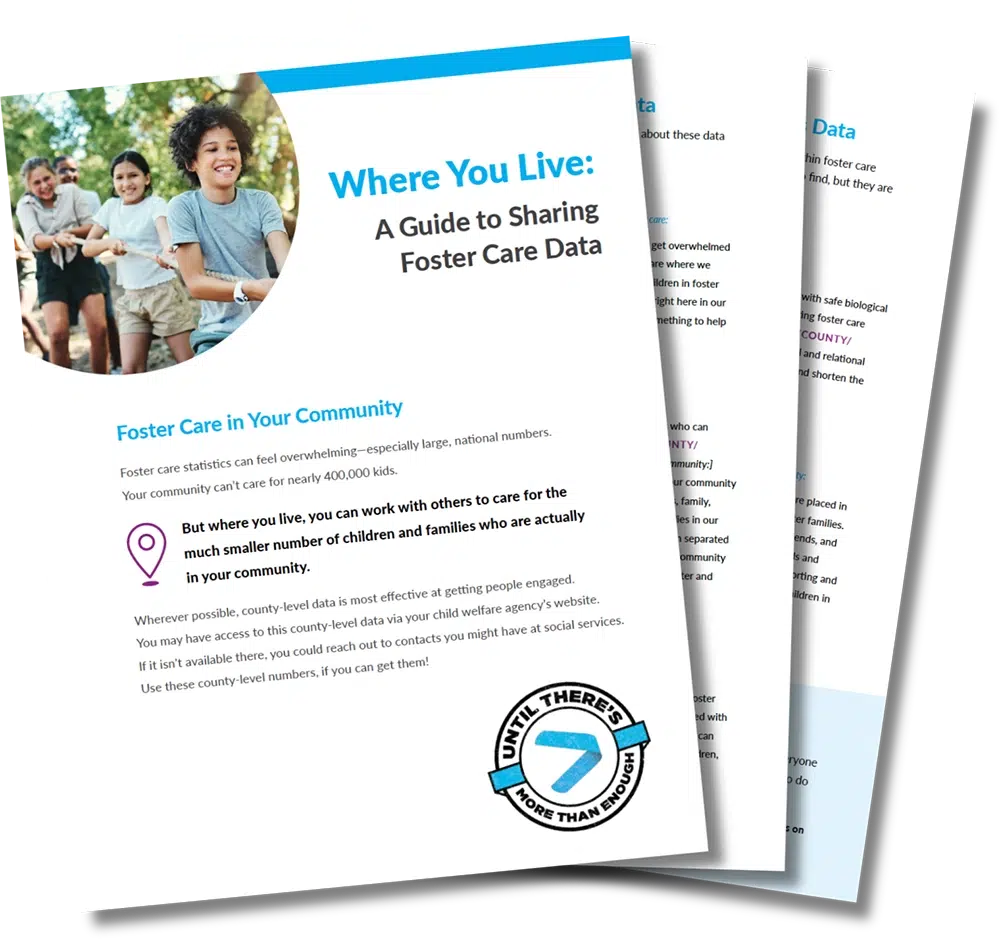
Share Foster Care Stats That Move Your Community to Action
Get 'Where You Live' - Your step-by-step playbook with tips and go-to language for turning local foster care data into compelling stories that inspire change.