*Editor’s Note: This is the second article in a series sharing the stories of CAFO members who are actively working to transition children from institutionalized care to family-based solutions around the world. Each of these organizations and leaders participated in the “Moving Toward Family Solutions” grant cohort led by the CAFO Research Center in 2024-2025.
The orphanage management was not pleased.
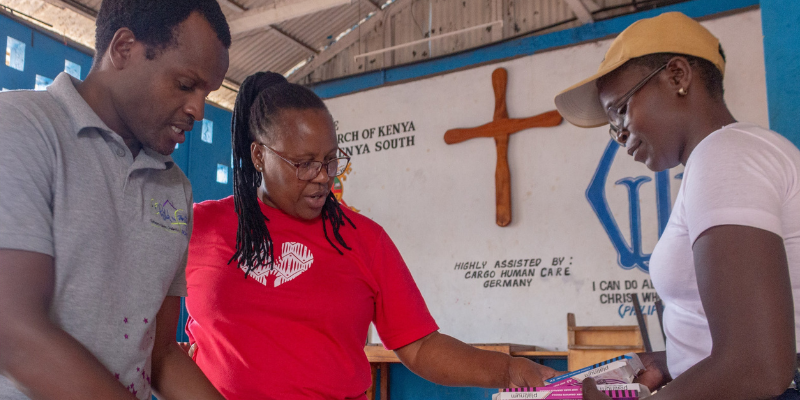
Peter Kamau, founder of Child in Family Focus Kenya (CIFF), together with project coordinator Florence Muteti, developed a child-friendly tool alongside government officials, the orphanage management and social workers to better assess each child’s personal readiness to return home. This was part of their preparation efforts to transition children out of the orphanage and back into families, which included everything from case conferences to family interviews and more.
They had never asked the children in the orphanage about their own feelings and perspectives, until now.

The tool was to be presented at a fun event where kids played in bounce houses, participated in fun games and enjoyed special treats. At the craft station, they were given the tool that included a new question for each child to reflect on: Do I miss home?
The responses were clear and striking: an overwhelming 87% of children said yes.
“When we presented the results to the leaders [of the orphanage] they were evidently not pleased with the findings,” Kamau said. Even though they had developed it in collaboration and were very proud of their efforts, Kamau said he knew immediately they needed to step back from showcasing the results if they wanted to preserve the relationship and move forward.
“We had to take a posture of humility and acknowledge this was a very hard reality for them,” he said. “For us to lose the very people that we wanted to journey with on the long haul toward getting children into families was not an option.”
Kamau knows not every child can be safely returned home, but he also sees that most boys and girls desire to do so. He hopes to help as many children as possible to rejoin family or extended relatives whenever that can be safely done.
The long road of advocacy
At CIFF Kenya, Kamau and his team regularly interact with orphanage leaders and the government as they walk alongside them in the process of transitioning orphanages to a new model of family-based care.
This includes advocating for best practices and long-term solutions for children, but also understanding the complexity for all parties involved – including the leaders and caregivers themselves.

“We often hear about their fears and concerns: Will my job be secure? What will happen to the infrastructure? What about this bus we have invested in? … For us, it’s important to be able to listen to them and be vulnerable with them, so they can express their fears, while still reassuring them to move forward,” he said.
Kamau, who grew up in an orphanage himself, is especially sensitive to everyone involved because of his background and experiences.
“Having lived within the very care that we are seeking to reform is for me a huge blessing. I know how it felt to be in that system. Now I am excited to be part of the work [to reform it] and ensure children are connected to families as early as possible.”
“God never wastes pain, but He makes something bigger out of every pain that we go through.”
To date, Kamau and his team have successfully supported 15 orphanages in care transition since 2012 in the regions of Nairobi, Kiambu, Kajiado and Ndaragwa, Kenya.
Knowing better and doing better
In 2024, Kamau and Muteti joined the Moving Toward Family Solutions grant cohort with the CAFO Research Center. Eager to learn from others and share their own experiences, they found a lot of value in the peer learning community as they shared similar challenges across different countries and cultures.
The learning cohort, supported by a $10,000 microgrant, brought five organizations together through the MTFS course with special coaching from CAFO’s Care Transition Coordinator, Dalia Mena.

“When I came across the phrase, ‘When we know better, we do better,’ I got so excited,” Muteti said, remembering when she first joined the cohort. “No one is a monopoly of knowledge. Yes, we were already in the field assisting children’s homes in transition, but we wanted to know even more.
“And I would say after the training, we are even doing better,” she added.
Kamau said he was especially inspired by the ways in which the church is actively engaging in this work around the world – something he wants to see happen more and more in Kenya.
“The ways you can plug into the church and get them involved, inspire them to action, and to join what God holds very dearly is something my team and I are very resolute to see happen here,” he shared.
Building a sustainable system for family-first approach
With their microgrant, the duo partnered with a residential home in a rural Sub County in Kenya. This particular subcounty has four children’s homes, none of which had embarked on care reform, Kamau said.
The CIFF team helped lay the groundwork for system-wide change, which included a number of community-based efforts to raise awareness and engage key stakeholders – from families and volunteers to the local police and village subchiefs. They also helped establish the first care reform committee and a system to recruit foster parents, provided training and built capacity to care for children in their homes, Kamau said.

“We knew the grant had a time limit, but if we went with a systems approach, we’d be able to ensure that the benefits of the grant go beyond the time we had,” Kamau said. “We believe the long-term impact is that children will benefit from being placed in a family first, as opposed to the orphanage being the first place they are taken after their own family’s crisis.”
CIFF Kenya has supported the recruitment of seven foster parents who have taken in seven children in this area to date, a hopeful first step toward seeing more children placed into families long-term. The team is continuing to walk alongside the orphanage leaders as they carefully assess each child’s case, placing the best interest of the child first.
“Peter and Flo each possess substantial experience and expertise in child welfare, but they still approached the grant cohort with humility and curiosity,” said Dr. Nicole Wilke, director of the CAFO Research Center. “It could have been tempting to create a quick and forceful project to satisfy the grant requirements, but they have been intentional in choosing a long-term approach, changing the system methodically, establishing local structures, and building a foundation that will bear fruit for years to come.
“Most importantly, they have honored the local leaders and not run them over,” she added, “celebrating the important role they play in seeing children cared for in families.”
Sharing knowledge with others

For Kamau, sustainability is about building lasting change, not just short-term projects. And that includes sharing important knowledge with others.
In August 2025, CIFF partnered with other organizations and the Government of Kenya to host the Kajiado SimLab. The CIFF Kenya team developed this by using the CAFO Research Center’s Simulation Lab – replicating real-world experiences of transitioning to family-based care. Stakeholders left with practical strategies, deeper collaboration, and a shared commitment to seeing children thrive in families.
“Every time we gather like this, we take another step forward,” Kamau reflected. “It’s a reminder that when we know better, we can do better — and that means providing safe, loving families for every child.”
– Jenny Pope is the Director of Communications at CAFO. All images courtesy of CIFF Kenya.
Experience what it’s like to transition to family care with ‘Sim-Lab’
Join us at this year’s Simulation Lab at CAFO2025 in Houston, Texas, on Sept. 30. This immersive simulation experience provides a safe and encouraging space for those involved in residential care to experience the process of transitioning toward family-based care. And if you’d like to learn more about hosting a Simulation Lab in your own community, please contact the CAFO Research Center at researchcenter@cafo.org.