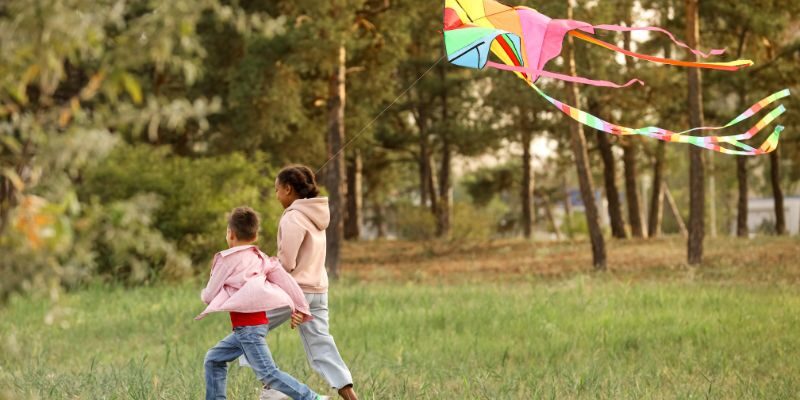
In this deep-dive blog post, we explore how Scripture and science highlight the benefits of spending time in nature — and how to arrange our lives to receive this gift. We’ll be exploring four key questions:
- What does Scripture say about the gifts of nature?
- What are the benefits of spending time outdoors?
- How can we structure our lives to prioritize time in nature?
- What small steps can our family take to spend more time outside?
What does Scripture say about the gifts of nature?
“And God saw everything that he had made, and behold, it was very good.” – Genesis 1:31 (ESV)
A person does not have to believe in God to look out the window at a tree or bird, or the blue sky and softly drifting clouds, and recognize that the world around us is good.
There’s a gentleness and splendor to the natural world, a soothingness and brightness that touches the depths of the soul. Glimpses of stars jewelling the night or the sound of birdsong from a solitary tree are enough to restore the spirit even in cities that crowd out much of the natural world.
The old and the young alike feel this goodness.
Some of my own earliest and most evocative childhood memories are of picking blackberries in Everett, Washington, as a 4-year-old girl; standing on the rooftop of our apartment building to see the few brave stars shining through the polluted night sky of Metro Manila; and the aching beauty of rural Philippine beaches, gentle and generous with gems from the sea. Most of us can recognize the powerful good that nature brings us, offering gifts without being asked and surprising us with a renewed sense of the beauty and goodness of life.
And this power is no accident.
We are creatures made for life within the created world.
At the completion of creation, the Bible tells us, “God saw everything that He had made, and behold, it was very good” (Genesis 1:31, ESV). Without hesitation, God declares that all He has made is good and reflects His own goodness, beauty and love.
Even the fall of man has not dried up this goodness.
Looking upward, the psalmist attests to creation’s enduring splendor: “The heavens declare the glory of God, and the sky above proclaims his handiwork” (Psalm 19:1, ESV). As Gerard Manley Hopkins wrote, though generations are bent by sin and all is seared by it, yet “for all this, nature is never spent; there lives the dearest freshness deep down things …” (emphasis added).
Despite the corrosion of evil, the grandeur and balm of the created world remain.
Creation is a gift to the whole person.
Creation helps us experience God’s character and faithful love.
The natural world communicates God’s existence, power and glory so as to leave none without knowledge of God and His righteousness. “For his invisible attributes, namely, his eternal power and divine nature, have been clearly perceived, ever since the creation of the world, in the things that have been made. So they are without excuse” (Romans 1:20, ESV).
It also makes plain His persistent mercy and patience. No matter what we do, “He makes his sun rise on the evil and on the good, and sends rain on the just and on the unjust” (Matthew 5:45, ESV).
Nature also reminds us of God’s faithful care for us and the freedom that gives us to seek His Kingdom first. When we see the splendor of flowers growing amid wild grass, we are reminded that “if God so clothes the grass of the field, which is alive today and tomorrow is thrown into the oven, will He not much more clothe you, O you of little faith” (Matthew 6:30, ESV)?
God’s creation can also support us as we learn to love.
Through all our senses, it helps us recognize that goodness is at the heart of all things. In nature, this goodness is vividly present to us and awakens hope of more goodness still to come. Isaiah sees the pent-up joy within creation that cannot help but burst for the goodness of God: “The mountains and the hills before you shall break forth into singing, and all the trees of the field shall clap their hands (Isaiah 55:12, ESV). We find creation’s energy delightedly directing toward God, and we are drawn to join that enthusiastic congregation of made things.
Being in creation can also enlarge our loves, fostering affection for all of the world God has made. In nature, we encounter such beauty, wonder and variety that we come to know it and treasure it. Nature invites a two-way relationship: it ministers to us, and it calls us to care for it. It lets us enjoy its fruits, and in turn, we are moved to protect and tend it. In loving the natural world, we share in God’s own delight in and care for creation.
What are the benefits of spending time outdoors?
“Nature is the best medicine.” – Hippocrates, philosopher and father of modern medicine
Research helps us further see the goodness of the natural world described in Scripture, showing that it profoundly supports human health, sturdy development and emotional flourishing.
Particularly for children, free outdoor play is essential for physical, mental and relational health and development. When children do not have regular opportunities to spend time outdoors, evidence suggests they are more likely to experience poorer mental health as adults.
By contrast, longitudinal research indicates that children who spend more time outdoors tend to have better mental health outcomes in adolescence and adulthood.
Doctors are increasingly prescribing time in nature as a remedy for mental, behavioral and physical health concerns, especially for at-risk youth and families. The gains are striking.
1) Time in nature improves physical health.
Research suggests that time outside contributes to physical health by:
- Helping children be more physically active and develop strength, stamina and coordination;
- Naturally nudging toward healthier food choices and greater satisfaction after meals;
- Improving sleep duration and quality; and
- Boosting immune health and supporting the brain-gut axis.
2) Exposure to nature reduces pain.
Nature’s mechanism of pain reduction is twofold, including both:
- Providing an analgesic effect, reducing not only the perception of pain but also calming brain activation in pain-processing areas; and
- Minimizing psychosomatic symptoms tied to depression and anxiety, such as headaches, digestive issues, racing heart and fatigue.
3) Spending time outdoors is associated with better mental and behavioral health.
Time in nature helps stabilize the brain’s stress response systems. Those with the greatest struggles often benefit the most, and the more time and immersion in nature, the greater the gains, including:
- Reduced anxiety and depression;
- Less repetitive negative thinking;
- Lower frustration and agitation;
- Decreased anger in children;
- Reduced need for ADHD and antidepressant medication; and
- Fewer ADHD symptoms beyond the benefits of physical activity alone.
4) Being outdoors supports cognitive skills, including executive functioning,
This benefit includes naturally:
- Improving working memory;
- Helping children stay on task in subsequent learning;
- Offering greater cognitive benefits when active outdoors than when active indoors; and
- Developing critical thinking skills through outdoor risky play.
5) Nature strengthens relationships.
Time in nature helps set the table for healthier relationships by:
- Increasing our sense of closeness to and appreciation for others, with a dose response so that more time often yields more connection;
- Boosting empathy, generosity, trust and agreeableness when we see nature, even in children and adolescents; and
- Reducing aggressive behavior and improving social and behavioral health in children as they engage in risky outdoor activities, including rough-and-tumble play.
6) Nature promotes emotional and spiritual rest.
The wonder of the natural world also lifts our eyes off ourselves and expands our loves by:
- Offering the relief of feeling small, which may in turn support self-giving behavior;
- Strengthening our sense of connection with nature itself, with others and with life as a whole;
- Reducing anxiousness through this connectedness, even in those with stronger neurotic traits, and supporting further positive relational experiences; and
- Bolstering meaning in life, perhaps especially for those with more callous-unemotional traits, who often struggle with empathy and guilt.
The potential benefits of spending time in nature are almost overwhelming in their abundance. What’s clear is that nature vitalizes. It makes us more alive — physically stronger, more at ease, mentally sharper, less weighed down by ourselves, more aware of the world around us and more appreciative of the people in our lives.
In these and other ways, nature gives life.
How can we structure our lives to prioritize time in nature?
“There was a child went forth every day, And the first object he look’d upon, that object he became…” – Walt Whitman
To encounter all these gifts, however, requires one thing: we must spend time outdoors.
Modern life has become increasingly cut off from the natural world. Children have far less free and independent time, especially outdoors. This shift has corresponded with a dramatic rise in depression and anxiety among adolescents.
Screen time has displaced much that makes up a healthy childhood, including time outdoors, along with sleep, embodied relationships and family meals. As Jonathan Haidt argues in The Anxious Generation, childhood has shifted from outdoor and play-based to phone-based. We need to recover these sources of good in children’s lives by making time in nature an anchor priority in daily life.
Three crucial prerequisites to help children spend more time outdoors
If we want children to spend more time in nature, there are three resources we have to guard:
- Time – Longitudinal evidence suggests that the more time spent in nature, the better. Bigger blocks of time are associated with greater improvements in well-being. At the same time, even periods as short as 10 minutes carry benefits.
- Space – Whether a backyard, cul-de-sac, park or trail, children need places where they can explore and interact with the natural world.
- Freedom – Children need the opportunity to experience freedom in small, bounded doses, allowing them to take risks and explore by climbing trees, rolling down hills or building forts with friends. Unstructured outdoor play helps children overcome fears and develop confidence and resilience.
Unfortunately, time, space and real-world freedom are all in short supply in many children’s lives today because we’ve set up patterns and rhythms that can inadvertently undermine them.
Treat outdoor time as a non-negotiable
With the best of intentions, we often fill our children’s lives with structured activities. To make room for outdoor activities, families need to build them into their schedules just as they would any other valuable commitment.
It must often be treated as nonnegotiable, sometimes even displacing academic or therapeutic activities. Parents can invest heavily in academic supports, only to keep children indoors longer and work against many of the gains that naturally come through time in nature and unstructured play.
Given the magnitude of benefits, time outdoors will often complement — and at times even surpass — other enrichment efforts.
This is true, for example, with sensory processing difficulties. Many children today spend so much time indoors that it may itself be contributing to sensory struggles. We may then try to recreate indoors what would more naturally come through outdoor life. Difficulties often described as oversensitivity, underresponsiveness, sensory seeking or struggles with balance and coordination may be improved by time in nature.
Outdoor spaces offer the rich sensory input children need to strengthen their bodies and support healthy sensory integration. In many cases, this is far better than the artificial sensory experiences we try to create or pay for indoors.
Limit the power of screens
Pockets of free time are also easily overtaken by screens. To allow children to experience the profound benefits of nature, families will need to be serious about establishing and maintaining significant screen limits. Firm family technology rules can be difficult to establish at first and require steady follow-through. But a commitment to real-world, in-nature experiences rather than a screen-dominated childhood is one of the greatest gifts parents can give their children.
Embrace appropriate risk
We also naturally want to protect our children from harm, so we may hesitate to allow them the space and freedom to explore, make mistakes and test their limits. But healthy childhood development includes some measure of acceptable risk.
Little freedoms in nature give children real-world experiences of choice and consequence. These freedoms allow children to experience the possibility of excitement and reward, but also of hurt, disappointment or loss. In that way, the natural world becomes a kind of school for life. It helps children weigh choices, handle setbacks and face later challenges with greater wisdom and sturdiness.
In fact, outdoor risky play is valuable for all children, including those with particular vulnerabilities and limitations. At times, excessive protection and lowered expectations, though well meant, can unintentionally diminish a child’s confidence, sense of capacity and belonging. Manageable risks a child can assess and navigate help support independence, responsibility and meaningful participation in the life of the community.
What small steps can our family take to spend more time outside?
“Never be within doors when you can rightly be without.” – Charlotte Mason, 19th-century British educational reformer
The wide-ranging research above suggests that alongside, and perhaps before, many other interventions, ensuring that children have the opportunity to play outside every day is a common-sense, high-benefit way to support healthy development and growth.
As families seek to support healing, health and growth in their foster and adopted children, they should, where possible, limit indoor and screen-based activities and prioritize outdoor play.
But on a practical level, where do you start introducing more time outside into your family’s life?
Here are a few suggestions for families who want to make time outdoors part of everyday life:
- Use this resource to talk together about the remarkable benefits of time in nature and the constraints — including parental fear — that can make it difficult to create room for it.
- Plan with other parents to set up times and places for children to play together freely outdoors. An adult can be present for safety without directing the activity. Aim for an environment that is as safe as necessary, not as safe as possible.
- Don’t wait for long stretches of time to open up. Even 10 minutes outside improves well-being, regardless of the activity. For parents and caregivers, too, brief times outdoors can help prevent burnout.
- Take indoor activities outside. Let the patio become the place for homework, or eat dinner in the yard or at the park when you can.
- Swap an indoor family activity for something outdoors. Instead of a show, play a backyard game of soccer together.
- If possible, try to watch the sun rise or set. Beyond the golden beauty of these moments, low-angle light helps set circadian rhythms and supports good sleep.
- Help your child learn to enjoy being in nature on their own by providing regular times for them to be outside independently to play, think or journal.
- Consider planting a small garden together or letting your child have a garden plot of their own to steward. Gardening reduces anxiety and depression, improves life and relationship satisfaction and encourages healthy eating.
- Plan for longer times when your family can spend a whole afternoon or even a weekend in nature. Longer and more immersive outdoor experiences offer added benefits.
- Take a weekly day of rest — a Sabbath day — that includes time in creation.
In a time when childhood is increasingly indoors, structured and screen-heavy, making room for outdoor life requires incredible intentionality.
Yet it is one of the simplest and most powerful ways we can support healing and health in children and in ourselves. For families and those walking alongside them, confidently prioritizing time in nature opens the way to receive its many gifts and to grow in flourishing.
– Rachel Medefind is the director of the Institute for Family-Centered Healing & Health.
For more content like this, please subscribe to the Institute’s monthly email list here.