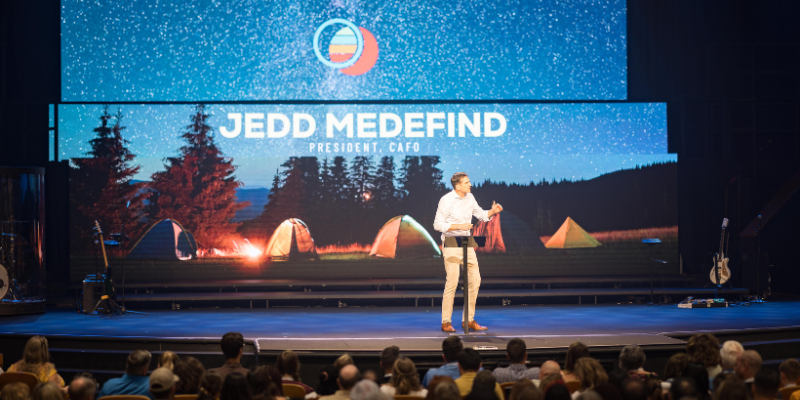
CAFO President Jedd Medefind opened the CAFO2025 Summit in Houston, Texas with a deep dive into the conference theme, “DISTINCT: Different from the world, for the world.” Watch the keynote below along with the written version of the talk.
[Read full transcript below.}
What a beautiful moment: here, now, together … with this community — from all over the world — receiving and giving — such good gifts from God, through one another.
You know — for me, maybe for you — this moment in history feels fraught, unstable, like the world we know could be very different 5 years from now … even 5 months. AI. Economic shifts. Wars. Clash of politics and culture. There’s opportunity — immense — but also hazard. We do not know where it will go.
But my friends, of this we can be sure: what our world needs from us now is not just more of what it already has.
Life without God cannot sustain a soul

Few people have opposed religion as effectively as Ayaan Hirsi Ali.
She joined the Muslim Brotherhood as a girl in Kenya — full of zeal. But as she grew, Ali began to question what she saw: violence, harsh control, the hatred it kindled in hearts, including her own.
At 22, Ali fled to the Netherlands to avoid a forced marriage. Immersed in Western culture, her doubts about religion grew.
Then came 9/11. Seeing former friends cheer as thousands died brought Ali to a tipping point. Religion, she knew, was no solution to the human condition — it lay at the heart of the problem.
Ali had a brilliant mind, spoke six languages. She rose like in a fairytale, from refugee housecleaner to member of the Dutch Parliament. As a young political leader, she boldly confronted radical Islam. Even when one of her partners was murdered by a terrorist, she pressed on.
Facing constant threats, Ali finally immigrated to the US. She wrote best-selling books, spoke widely, held respected titles.
Her tireless assault on religion made her a fifth member to the famous “Four Horsemen” of New Atheism. One of them, Christopher Hitchens, called her “the most important public intellectual” to come out of Africa.
So little wonder the world was shocked when, two years ago, Ali penned an article with this title: “Why I Am Now a Christian.”
The first reasons she gave had to do with civilization. She’d come to believe that science and progress alone were simply not enough to preserve Western civilization from all that threatened it — from communist China and terrorism to academic nihilism.
But Ali did not stop there. Her essay led ultimately to deeper, more personal reasons. “I have also turned to Christianity,” she wrote, “because I ultimately found life without any spiritual solace unendurable — indeed very nearly self-destructive.”
Last September, Ali was baptized, along with her two sons and her husband, the brilliant historian Niall Ferguson, who describes himself now as a “lapsed atheist.”
Ali and her family are still young in their faith, grappling with questions as they go. But they’ve seen enough to believe there is no other hope.
Life without God cannot sustain a single soul, let alone a civilization.
It’s spreading
Ayaan Hirsi Ali and Niall Ferguson are not the only ones feeling this. If you scratch the surface of secularism today — from universities to tech start-ups — you’ll find a strange phenomenon: faith is sprouting in the most unlikely places.
Look to the Left coast. The San Francisco Bay Area is one of least religious places in the US. Among people older than 60 there, less than 1/3rd say they’re even “curious” about the Bible. But ask younger folks there the same question, that number doubles — nearly 60% are curious and say they “wish they used the Bible more.”
We see similar things in the UK, too — some call it a “quiet revival” among the young. Still small, but just in the last six year, the portion of young people who attend church regularly has quadrupled – from 4 to 16%.
What’s driving this? If you listen close, you’ll hear. Often, it’s doubts. Doubts. This new skepticism, however, is not primarily toward religion. Rather, it is a loss of faith in the things that many had long assumed could replace religion — from technology and progress to therapeutic culture. You might call it a deconstruction … of unbelief.
Why the rise in religious interest?
There is good reason for this skepticism. Over the past 15 years, measures of wellbeing have plummeted across the West. Anxiety, depression, suicides and other markers of a soul-deep unwellness have skyrocketed, especially among the young.
The Center for Disease Control reports that 4 in every 10 American teens say they feel “persistently sad and hopeless.” For girls, that number is over 50%. “Persistently sad and hopeless.”
The recent murders that have rocked the US — at the Annunciation Catholic school, Iryna Zarutska, Charlie Kirk — these tragedies not only break our hearts; they confirm a profound sickness of hearts, of culture.
No wonder many thoughtful observers — even the nonreligious — are feeling deep down in their gut that young people – and all of us, not only in the West — need more than secularism can provide. More than we’re getting from Silicon Valley and Hollywood and elite universities and self-focused therapies.
My friends, we should be sobered by this reality. Heartbroken. Yet there is also something bracing in facing reality. It can rouse us — like emerging from a stuffy basement to the icy cold of a winter morning.
I believe it’s a challenge, an invitation: to consider a way of life that is truly different, distinct. A way of life that does not just mirror the priorities and patterns around us. It’s the ancient call of God to His people, “Do not conform any longer to the pattern of this world … ”
The point is not that our era is the worst of all time. Far from it. We enjoy privileges kings could only dream of. This is a great time to be alive!
It’s just that every era — every society, every culture — needs something far beyond itself. West and East. Rich and poor. Every moment in history cries out for truth and life and grace of a kind that are always in short supply.
And mark this: We can only offer those gifts if we are willing to be truly, boldly distinct.
You know, when I was a teenager, at a big public high school in CA, I really wanted to live for God. I also really wanted to fit in, be cool.
There were times when I was willing to swim upstream — miss the parties, share my faith. But there were also times when I convinced myself that I could be most useful for God by fitting it — being successful, being relevant.
In other words, being as much like the world as I could be without sinning.
If the world was Coke, it was as if I thought Christians should be Diet Coke — all the same taste, just without the calories and cussing.
My friends, that is not what our world needs. That’s not what it’s aching for — just more of the same with some of the worst ingredients removed. That kind of Christianity yields feeble faith, tepid lives.
Coke will not slake our neighbors’ thirst. Neither will Diet Coke. They need water from a pure, cold mountain stream. Or, how about — especially you Texans: Topo Chico?
Living differently makes a difference
So here’s the great news. When we live this way — truly distinct — it really makes a difference. Tangible. Measurable.
Look at this headline from the Boston Globe: “Why are religious teens happier than their secular peers?”
Or this heading from Jonathan Haidt’s Substack:
“Religion protects young people’s mental health.”
I love Jonathan Haidt. His writing is brilliant, immensely important. He’s not a believer — not yet. But he unapologetically reports that kids from devout families – who seriously live their faith — are doing dramatically better than their peers.
The data show this in virtually every area of life: their mental health, physical health, relationships with their parents, friendships, purpose and much more.
Look at this study from the Springtide Institute. They asked teens about their mental health and flourishing. Among youth who describe themselves as “Not religious,” more than 4 in 10 rate their lives in the worst category, “Not flourishing.” Less than 2 in 10 say they are “Flourishing a lot.” BUT … when it comes to youth who report being “very religious,” those number completely flip. Only 2 in 10 say they are not flourishing, and 4 in 10 say they are “flourishing a lot.”
Now of course, there’d be lots to discuss in data like this — nuances, caveats. But I think this much is clear: the best studies, the best science increasingly confirm what many of our grandparents could’ve told us all along.
They confirm that the ways of God are deeply good for human beings. Thanksgiving. Forgiveness. Serving others. Moral boundaries. Confessing sin when we blow it. Parenting that is both kind and firm. The light yoke of self-forgetfulness.
Friends, our world is aching for these gifts. Good science increasingly affirms them. Humans do not flourish without them.
So why wouldn’t we put these things at the very center of our organizations? At the center of our programs — the most important things we have to offer, the most effective strategies for bringing new health and life to wounded children and families?
I don’t mean that in a sentimental way — a cheap “Jesus is the answer” mindset. I don’t mean just taking the latest development program or therapy and sprinkling some Bible verses on top.
I mean that whatever other good things we may offer, this should be the burning core: to help children and families know God and walk in His ways — because that’s what we’re made for, that’s how humans flourish.
You know what Jonathan Haidt has to say to us about this: a nonbeliever to Christians? A few weeks ago, he was on a podcast with a pastor, talking about the things that people need to thrive: real community, moral vision, sustained practices that really bring health.
And he said this — Quote: “the biggest repository is Christian churches, church communities … ” It was like he was begging us not to miss the preciousness of the gifts we possess.
Don’t exchange real community for screens. Don’t sacrifice a rooted family life for overloaded schedules. Don’t trade the depths of Christian wisdom for therapy speak.
Sometimes it takes a voice from the outside to see what we’ve had all along.
No, not easy
Now let’s pause for a sec, because there could be a danger here. Christianity is not a tool for life optimization. Jesus never says that if we follow Him, life’s gonna be dandy. Look at Job. Look at the disciples, saints throughout history. Many of them died a bloody death. None of them had it easy.
And folks, look at us! Even at our best, we are sinners saved by grace. The Church isn’t Gold’s Gym … where we go to sculpt big biblical biceps. No way. We are stroke victims, all of us, bent by the Fall, learning to walk again.
And yet, and yet, the Apostle Paul – who called himself “the chief of sinners” was also able to say with integrity, “Follow me as I follow Christ.”
How could he say that? Because he was confident, as we can be confident … that when we respond to God’s invitations, seek to align our heart with His heart, our will with His will in small choices, even stumbling steps – He will remake us. He can rewire us, down to our neural circuits – teaching us to walk again, in His ways, more like Jesus every day.
And that will make us very different that everything around us.
What’s holiness?
The old King James language helps us to feel this reality. It describes us as “aliens,” “sojourners,” “strangers” on earth, a “peculiar people.”
In one word, it’s this: Holy. Holy. “Be ye holy, for I am holy.”
Now, the word “holy” comes with all kinds of baggage today. We might imagine a snooty butler with white gloves, checking for the smallest spot of dust. “Hmmmph!” Holier than thou.
No. No! That is not the Bible’s idea of holiness.
Hear these words from Deuteronomy 10: “For the Lord your God is God of gods and Lord of lords, the great God, mighty and awesome, who shows no partiality and accepts no bribes.”
The God we worship is utterly above, set apart — can’t be corrupted. But you know what the next line is? “He defends the cause of the fatherless and the widow … ”
Yes, our God is totally pure, unpolluted … and yet at the very same moment He’s right there with the most vulnerable, the hurting, the forgotten – down in the mud if need be.
That’s God’s holiness. And that’s the holiness He calls us to also.
“Religion that God our Father accepts as pure and faultless is this: to look after orphans and widows in their distress … and to keep oneself from being polluted by the world.”
Pure heart, muddy hands.
We are to be both holy and helpful. Or rather, deep helpfulness flows from true holiness.
A whole life vision
So let’s get really practical. What does it look like, feel like, to live that way — not perfectly, but earnestly, substantively?
I got to see it up close, vibrantly, when I was just out of college. Three close friends and I spent that year traveling and living in the homes of faithful believers all over the world — joining them in their work.
Truth is, we set out to find adventure — life to the full. We did – we found it. But not where we’d expected — in far off places and adrenaline. We saw it in ordinary people, followers of Jesus living faithfully for him right amidst their ordinary places.
We saw it in Zhenia. He grew up a Christian in Soviet Russia. His dad was shot by Stalin. Zhenia was arrested as a teen. They wanted him to inform the KGB on fellow believers. When he refused, he was left in prison for years — but he never backed down.
We saw it in Salomon and Mery in Guatemala. They were Ladinos, from a more European bloodline and culture. But they chose to live and serve among the indigenous Mayans, whom many Ladinos despised.
We saw it in Phu in Vietnam, hardly older than we were – but he risked his freedom most every day to share the gospel.
In many ways, these beautiful brothers and sisters looked a lot like their neighbors — ate the same foods, dressed the same. They were not needlessly oppositional. But they broke with their culture wherever it did not align with the ways of God. They were very good neighbors — the best … but also very different.
I’ve seen that here in the US, too.
I think of my dad — nearly 40 years as a teacher in a public high school. First day each year, he’d say to the class, “You may or may not believe there’s a God. But I do. And I believe He put you in this class for a reason.”
He loved his students, and they knew it.
I still can still hardly go anywhere in my hometown – grocery store, car wash – but if someone sees my last name, they’ll say, “You’re Mr. Med’s son!?” I always know what comes next: “He was my favorite teacher!” And then they’ll launch into a story about how dad helped them or cared for them or stayed after school to talk when their parents were getting a divorce.
My mom was the same. She was a teacher, too – but gave up the title and income when I was born – to pour into my brothers and me. She loved us so well, and many others, too.
And you know, day after day, I saw where their distinctiveness came from.

My dad is manly, rugged. Every summer, he worked as a horse patrol ranger in Yosemite National Park – mustache and all. But I don’t remember him and mom almost ever watching an R-rated movie. He loved all kinds of music too, but listened mostly to hymns and worship songs.
Was that legalism? No. He just believed that Jesus knew what he was talking about he said that what fills our hearts and our minds will always spill out. Little choices. Small habits – especially in our thoughts – are the wellspring of everything else. A distinct life always starts with those small, daily choices.
Virtually every morning, I’d look down our hallway to the living room, and I’d see my dad there in his green-striped chair, reading his Bible, praying — for us, for his students. He’d memorize scripture, too — with verse cards in his truck or on the bathroom mirror.
I think of others I know:
- A doctor who prays with his patients.
- A couple who live way below their means so they can give more away.
- A business owner who hires foster youth to mentor them.
- Families that really limit their smartphones so they’re more present to God and others.
- A prisoner — who’s serving a 10-years sentence right now. He did some bad things, but came to faith behind bars, and now every month he sends money he earns from prison labor to help CAFO’s work. He and I have been writing letters. His last said this, “Please pray that [God’s] tender-hearted compassion for others will grow in me … [S]ometimes these guys are hard to love and deal with.”
Man, that’s straight up Topo Chico.
Shine like stars
It’s beautiful. But in our last few minutes here, let’s count the cost. A distinct life is many good things, but it is not a path to ease or comfort.
I think of many people in this room – ministry leaders, foster and adoptive parents, people serving in hard places all over the world: you’ve been through the fires. Some of you are still there.
And yet, even in the thick of that, I see such purpose … vitality … a deepening of souls. You aren’t the same people you were ten years ago. You bear scars, but there’s a light in your eyes and a weightiness to your presence — far more, I think, than if you’d just settle for a more comfortable life.
When I see that, I think to myself: Jesus knew what he was talking about when he said that we only we find our lives by losing them.
And Paul, he knew what he was talking about, when he said that we can rejoice even in suffering — because in Christ, suffering produces perseverance, and perseverance character, and character hope. And hope does not disappoint.
In fact, I’m reminded that all of the peculiar, counter-cultural things that Scripture calls us to are deeply good for us:
- To give thanks in all circumstances
- To consistently fill our minds with what is good and noble
- To honor our father and mother, even if they don’t deserve it
- To give no place to lust or greed – even in our thoughts
- To gather often with God’s people
- To forgive 70 x 7
- To pray for enemies and bless those who curse us
All these things are rare — counter-cultural — in any culture in the world.
They are gifts to others. They are gifts to ourselves. The ways of God are good for us.
And whatever happens in this fraught and fragile moment we’re living in … whatever happens with politics, with the economy, with wars, with AI, with own struggles.
Whatever plays out, we can be confident that a truly distinct life, with God and for God, is the best life … even when it’s really hard.
My friends, this is no time for timid faith, for half-hearted lives. It’s a time for courage and good cheer — for lives that are truly distinct, receiving God’s good gifts and sharing them boldly with our neighbors, too.
And here is God’s promise as we do. “And then you will shine among them like stars in the sky as you hold firmly to the word of life.
– Jedd Medefind is the President of the Christian Alliance for Orphans. See more highlights from CAFO2025 Summit in Houston, Texas here.