Our primary goal as the Church is not recruitment or activism; it is discipleship.
Ultimately, it is to see the people of God deeply celebrating the love of God shown through the work of Jesus, and then widely demonstrating that love to those around us.
This relationship between identity and action – allowing who we are (because of what’s been done for us through Christ) to flow into what we do for others – is both the greatest testimony to the power of the gospel in our lives and the most poignant answer to the prayer Jesus Himself taught us to pray: “May Your Kingdom come on earth as it is in Heaven.”
Regularly celebrating the power of the gospel and finding ways to demonstrate that gospel into the world around us does just that – brings the Kingdom from there to here.
It’s such a joy to get to stand before others, open the holy Scriptures and proclaim the truths of God and the beauty of the gospel. And it’s such a humbling task that carries with it a significant, eternal gravity. It requires a prayerful disposition, a full and sincere heart and an uncompromising integrity to the Word.
Scripture and principles to use when teaching on Pure Religion Sunday
Pure Religion Sunday is a unified, global day in which churches intentionally focus on God’s heart for vulnerable children and families and inspire their people to take action. As the date draws near, we want to make sure you have the tools, resources and frameworks you need to teach or preach about this with great clarity and conviction.
First, we’ll focus on some helpful content in Scripture, including biblical themes, passages and key theological truths that help build the scaffolding for speaking on this topic.
Second, we’ll offer some tactics to help you make the most of this day, as you share about God’s heart for the vulnerable and call your people to respond.
We do in response to what God has done.
When speaking about foster care, adoption, family support or orphan care, it’s important to note that before we are preaching about engaging in a cause, we are first preaching about engaging with a God who has lavishly demonstrated His care and protection on us through the work of His Son, Jesus.
We are preaching the gospel – first inviting people to more deeply celebrate its truth and impact, and then calling them to demonstrate that gospel in very specific ways to the world around them.
We are preaching at the intersection between celebration and demonstration, not as mutually exclusive ideas but as coexisting paradigms that ultimately transform hearts and drive action.
As you do this, consider focusing on God’s actions as a loving Father throughout Scripture, as well as the correlation between His actions and our calling to care for children and families who lack protection and provision.
Three key themes to consider when preaching
Here are a few predominant themes to consider sharing to inspire your church with truth about God’s heart for the vulnerable:
God incarnates.
All throughout Scripture we see a God who moves toward hard places and toward struggling people. This is God’s consistent method of operation.
Matthew 1:23: “The virgin will conceive and give birth to a son, and they will call him Immanuel” (which means “God with us”).
John 1:14: “The Word became flesh and made his dwelling among us…”
In the incarnation, God wraps Himself in the brokenness of our story. He is willingly broken by our brokenness, in order for us to experience healing, hope and restoration. This then becomes the place in which God calls us to “visit” the most vulnerable among us. It’s through this act of moving toward the vulnerable, the struggling and the lonely, that the heart of God is put on display in vividly “pure and undefiled” ways. (James 1:27)
God welcomes.
When God moves toward us in our need, it is always within His character as a good Father to welcome us into His family. He assumes the role of Father, inviting us into His eternal provision and security as His dearly loved sons and daughters.
Psalm 68:5-6: “A father to the fatherless, a defender of widows, is God in His holy dwelling. God sets the lonely in families…”
John 1:12: “to those who believed in His name, He gave the right to become children of God.”
Being welcomed into the family of God through the work of Jesus – and experiencing the provision and security that comes from knowing we are fully loved – becomes the impetus behind our actions toward others.
Whether through adoption, foster care or another form of opening our lives, our families and even our homes, welcoming others is a correct and necessary response to God welcoming us.
God protects.
As any good father would do, God guards us in His strong and mighty arms of protection, fending off that which seeks to destroy us and defeating that which we are powerless to fight on our own.
Among many other things, this becomes our place of great delight in the family of God – knowing that our Good Father is always for us, never against us. He is protecting, covering, shielding and making provision for us even when we as His children are wholly unaware of all He is doing. This is what a good father does.
Deuteronomy 10:18: “He defends the cause of the fatherless.”
It is within this place of safety and security that we are then invited to extend protection to the most vulnerable around us. In Isaiah 1:17 we see the clarion call to “…seek justice…defend the oppressed. Take up the cause of the fatherless; plead the case of the widow.”
On what grounds would God be calling us to take such a stand on behalf of others? On the very grounds that we are those who have first been the beneficiaries of the strong and mighty protection of God as our Father.
So in our preaching, we point people to the work of Jesus. We reinforce our new identity as those who do for others what Jesus has done for us. Then, we give clear pathways and calls to action for our people to take their next steps in obedience to what God is calling them to do.
Three strategies to make the most of Pure Religion Sunday
Consider these tactics to make Pure Religion Sunday as engaging and impactful for your church as possible.
Make it special.
Pure Religion Sunday is officially on the second Sunday of November. But, you can host it any time throughout the year! Dedicate a specific Sunday (or a full weekend) as an important moment in the life of your church. Use this day as a leverage point to inspire and drive action within your congregation.
Make it normal.
Preaching on this doesn’t always have to be a “special” thing; in fact, in many ways we want it to be a “normal” thing. Take every opportunity to spotlight when, in Scripture, you see God moving toward hard places and struggling people, not away from them. Incorporate this into the regular rhythms of preaching and teaching all throughout the year.
The Bible is littered with moments where we see God doing this. Use those moments as opportunities to reinforce vision for your church and invite people to take action.
Example: “Here again we see the character of God in how He moves toward a hard situation or a struggling person. This is the consistent action of God, and it’s at the core of who we are striving to be as a church. This is why we have strategically engaged in the space of caring for vulnerable children and families through foster care, adoption and global orphan care initiatives. And if you’d like to learn more about how to get involved in those spaces at our church, you can do so by….”
When we highlight moments where God moves toward the hard and broken in Scripture, we not only remind our people that this is who we’re striving to be as a church, but we give them specific and practical next steps they can take to engage.
Make it for everyone!
The “everyone can do something” message reinforces what is true in Scripture – that we’re not all called to the same thing, but we are all called to do something (see the description of the Body of Christ in 1 Corinthians 12 – some are eyes, some feet, some hands, etc.)
- Honor the diversity of your congregation’s gifts and passion areas by demonstrating the varied ways they can get involved and make an impact.
- Provide clear next steps people can take to find and do their “something”!
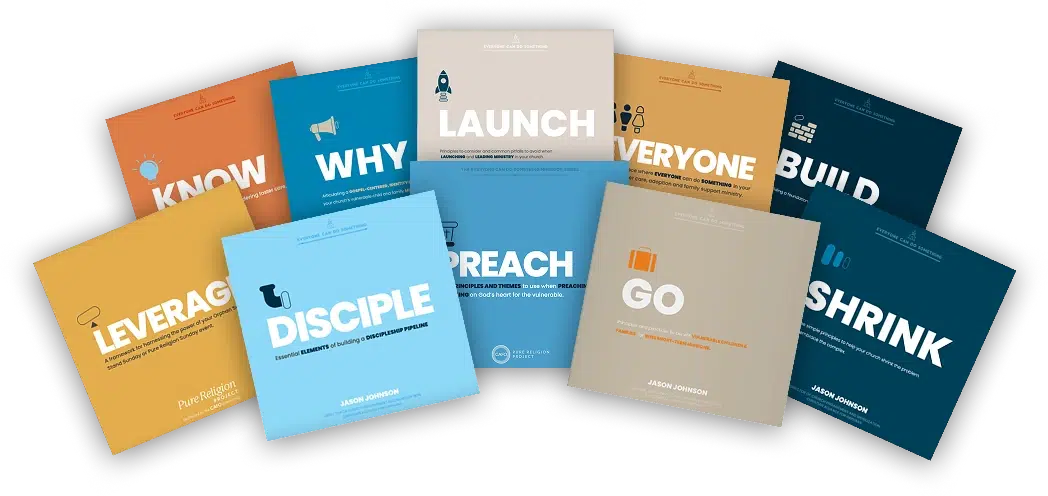
Check out Everyone Can Do Something to learn more about communicating and incorporating this message into the culture of your church and ministry.
As you prepare for this amazing weekend, we pray that the Spirit will prepare the hearts of your congregation and that you would see God work in incredible ways within your church, your community and your families.
-Jason Johnson is the Director of the Pure Religion Project at CAFO.
A few additional resources for preaching and teaching on Pure Religion Sunday:
- Sermon: “A Pure and Undefiled Reflection” by Jason Johnson, CAFO – In this sermon from our very own Jason Johnson, he speaks in-depth about the implications and invitations of the gospel in our lives and in the lives of the vulnerable around us.
- Podcast: “Father to the Fatherless” by David Platt, Pastor at McLean Bible Church in McLean, VA – In this episode, Pastor David Platt reminds us that the gospel is the solution to the foster crisis. In order to reflect Him to the world, we must reflect His heart for the vulnerable.
- Workshop: “Preaching and Teaching about the Gospel and God’s Heart for the Hurting and Vulnerable” by Jason Johnson, CAFO and Renaut van der Riet, Pastor at Mosaic Church in Orlando, FL – In this workshop, Jason and Renaut discuss how to effectively, humbly and biblically communicate God’s heart for the vulnerable.
- Worship Music & Resources: Father to the Fatherless – Not only can you preach about God being a Father to the fatherless, but your congregation can sing about these truths together as well! Check out “Father to the Fatherless”, the new EP produced by CAFO and The Worship Initiative. You’ll get access to the songs, devotionals, theology videos and more…all for FREE!